Protocol Buffers for PromoStandards: 80%+ Smaller Payloads, No One Else Does This
If you’re a developer at a promotional products distributor, you know the pain: syncing inventory and pricing across hundreds of suppliers means thousands of API calls per hour. Every byte matters. Every millisecond counts.
Today we’re announcing Protocol Buffers (protobuf) support in PSRESTful , making it the only platform in the promotional industry that offers this format for PromoStandards APIs.
What Are Protocol Buffers?
Protocol Buffers are Google’s language-neutral, platform-neutral mechanism for serializing structured data. They’re what powers communication between services at Google, Netflix, and most high-scale tech companies. Unlike JSON (text-based), protobuf is a binary format: compact, fast to serialize/deserialize, and schema-enforced.
If you’ve worked with gRPC, you already know protobuf. If not, here’s what matters: same data, dramatically smaller wire size, faster parsing.
The Numbers: XML vs JSON vs Protobuf
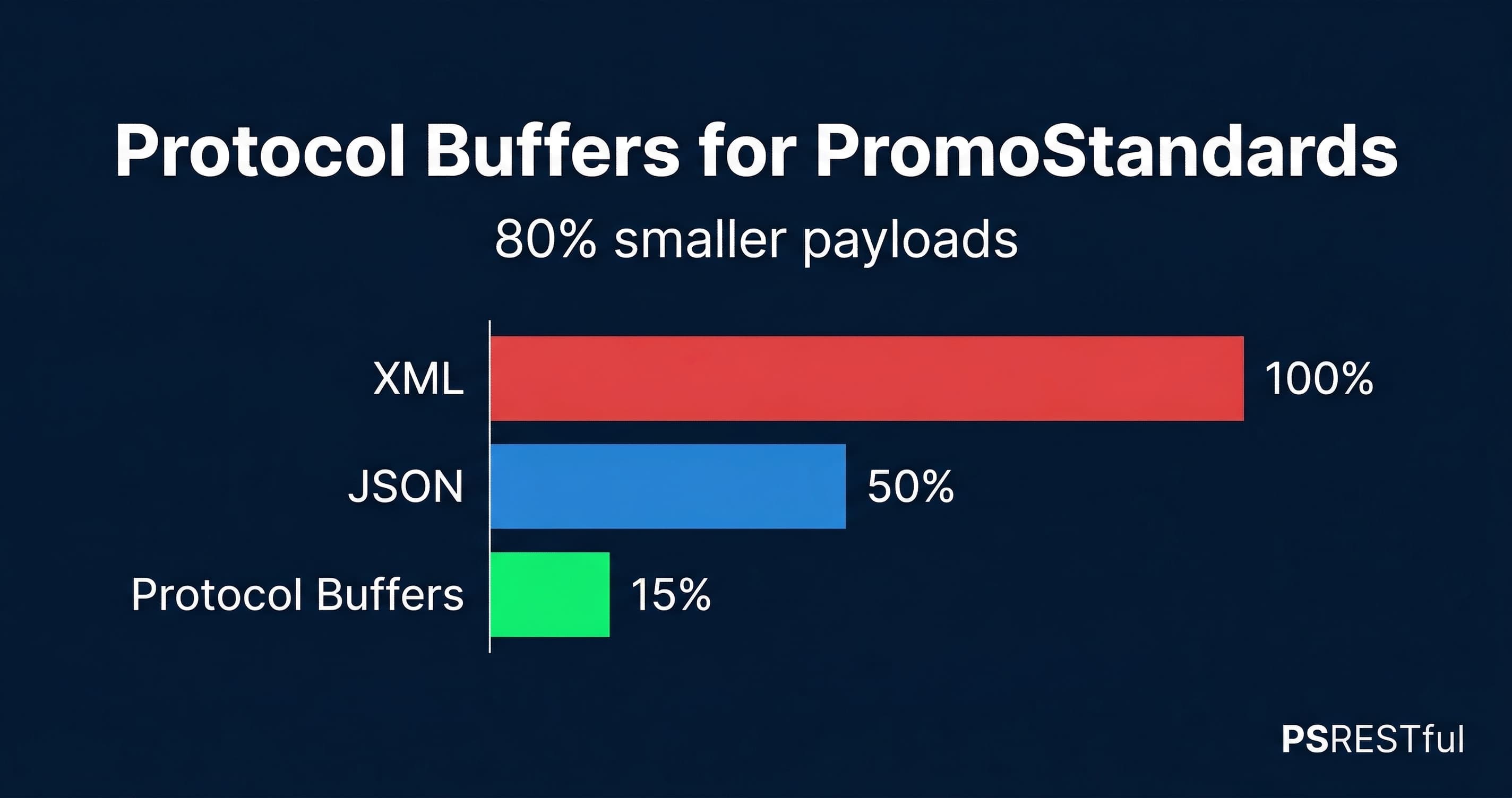
We’ve already shown that moving from XML to JSON reduces payloads by 35-53%. Protobuf takes this further:
| Format | Inventory (46 colors, 8 sizes) | Product Pricing | Relative Size |
|---|---|---|---|
| XML | 5.1 KB | 992 KB | 100% |
| JSON | 2.4 KB | 607 KB | ~50% |
| Protobuf | ~0.9 KB | ~150 KB | ~15-20% |
Protobuf payloads are 80-85% smaller than XML and 60-75% smaller than JSON. For a distributor making 50,000+ API calls per day, that’s a massive reduction in bandwidth, parsing time, and infrastructure cost.
Why This Matters for Your Business
This isn’t just a developer optimization. It’s a business advantage:
-
Faster inventory sync: When a hot product is selling out, your system gets the update quicker. Protobuf responses parse in microseconds, not milliseconds. That means your website shows accurate stock levels before your competitor’s site even finishes processing the JSON.
-
Faster pricing updates: Product Pricing and Configuration is the heaviest PromoStandards payload. Reducing 607 KB (JSON) to ~150 KB (protobuf) means your pricing engine stays in sync with suppliers in near real-time.
-
Lower infrastructure costs: Less bandwidth, less CPU time parsing responses, less memory. If you’re running at scale, this translates to real savings on your cloud bill.
-
More reliable at high volume: Smaller payloads mean fewer timeouts, fewer retries, and more headroom before you need to scale your infrastructure.
Protobuf + Caching: The Compound Effect
Here’s where it gets interesting. PSRESTful already provides intelligent caching that dramatically reduces response times for frequently accessed data. When you combine protobuf with caching, the effects compound:
- First call: PSRESTful fetches from the supplier’s SOAP/XML endpoint, translates, caches, and returns protobuf, already much smaller than raw XML
- Subsequent calls: Response comes directly from cache in protobuf format, with sub-10ms response times and minimal payload
For inventory polling scenarios (where you’re checking the same suppliers repeatedly throughout the day), this combination means you’re getting cached binary responses instead of waiting for XML round-trips. The speed difference is not incremental; it’s transformational.
How to Use It
If you’re already using PSRESTful, adding protobuf support is straightforward. Set the Accept header to application/x-protobuf in your API calls:
curl -H "Accept: application/x-protobuf" \
     -H "x-api-key: YOUR_API_KEY" \
     https://api.psrestful.com/v2.0.0/suppliers/SS/inventory/3501
The .proto schema definitions are available at github.com/GallardoSolutions/psdomain . You can use them to generate client code in any protobuf-supported language: Python, JavaScript, Java, C#, Go, Ruby, PHP, and more.
JSON remains the default and continues to work exactly as before. Protobuf is an opt-in upgrade for teams that need maximum performance.
Who Should Switch?
Protobuf is ideal if you:
- Make high volumes of API calls (10,000+/day)
- Run background sync jobs for inventory or pricing
- Build mobile apps where bandwidth is constrained
- Operate in latency-sensitive environments (real-time quoting, live inventory displays)
JSON is still great if you:
- Are getting started with PromoStandards integrations
- Need human-readable responses for debugging
- Have lower API volume where the overhead difference is negligible
No One Else Does This
Let’s be direct: no other platform in the promotional products industry supports Protocol Buffers for PromoStandards APIs. This is new territory. While the industry has been discussing the move from SOAP/XML to REST/JSON, we’ve already gone a step further by offering a binary format used by the world’s highest-scale systems.
The promotional industry processes billions of dollars in transactions. The technology infrastructure should match that scale. We think protobuf is a meaningful step in that direction.
Try It Today
Protobuf support is available now on all PSRESTful plans. Visit PSRESTful.com to get started, or check the API documentation for integration details.
Have questions? Want to benchmark protobuf vs JSON for your specific use case? Reach out . We’d love to help you optimize your integration.